


Marketing Isn't One Funnel. It's Three.

Updated: Sep 2
The biggest lesson I learned helping scale Passport from a relatively unknown startup to a successful $425M acquisition.
If you've spent any time leading marketing at a startup, you've probably heard some version of this question:
"So, how many qualified leads did marketing generate this quarter?"
It's a completely fair question. In fact, it's one I monitor closely on a daily basis.
But over the last few years, I've realized it's also one of the most limiting ways to measure marketing.
Not because sourced leads and pipeline doesn't matter—it absolutely does. Every marketing leader should know exactly how many conversations and how much pipeline their team is creating.
The problem is when that's all you measure.
At Passport, we spent the last three years rebuilding the company from the ground up. We repositioned the business, rebranded the company, expanded into Enterprise, launched new products, invested heavily in content, digital, events, partnerships, customer marketing, and thought leadership, and built a modern go-to-market engine that looked very different from the startup we first joined.

By the time Passport entered into an agreement to be acquired by Global-e for $425 million, one thing had become really clear to me:
Marketing wasn't creating value in one funnel.
It was creating value in three completely different ways.
And once we started measuring all three, we started making much better decisions.
Funnel #1: The One Everyone Measures
Let's start with the obvious one.
Marketing should absolutely be accountable for driving leads and creating pipeline.
During the first half of 2026, our team generated more pipeline than any other source. That pipeline creates real business value that originated directly from marketing programs, and they're some of the most important numbers we review every week.
If your marketing team can't answer those questions, that's a problem.
But I don't think that's where the conversation should stop. Because some of marketing's biggest wins never show up as "Marketing Sourced" at all.
Funnel #2: The Pipeline Marketing Helps Close
One of the biggest shifts we made was moving beyond attribution and starting to think about influence.
Think about all the moments where marketing makes a deal easier to win.
A prospect sees your CEO on LinkedIn six months before they ever book a meeting.
A BDR shares a customer story that marketing published.
A buyer attends a webinar, visits your booth at an event, downloads a report, then finally converts after talking with Sales.
Who gets credit for that?
Technically...probably not Marketing.
But did Marketing help create that opportunity? Absolutely.
That's why we started tracking influenced pipeline and influenced bookings alongside sourced pipeline.
During H1 2026 alone, one channel in our paid digital program influenced more than $17M in pipeline*, while our events program have influenced another $2M+ in closed-won revenue.
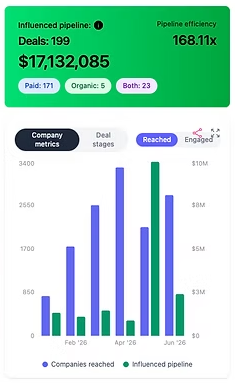
*Data shown is conservative as it's for only one channel, LinkedIn. Does not capture full influence scope of all Passport digital channels.
Marketing didn't have the last touch on those opportunities to take attribution credit for them, but they almost certainly closed faster—or closed at all—because Marketing was part of the journey.
That changed how we viewed ROI and how we tell the story of marketing's full impact.
Funnel #3: The One Salesforce Can't Measure
This is the fun one...
And honestly, I think it's the one startups undervalue the most. Because this is where brand lives.
Brand isn't just impressions or fancy creative.
It's what happens when your BDR or AE gets a reply because someone has actually heard of your company.
It's when a partner says yes because they've been seeing your content for months.

It's when more candidates want to work for you.
It's when outbound feels just a little bit easier because trust already exists before the first conversation.
Good luck finding that in a Salesforce report. And yet, those moments compound over time.
In my opinion, this is where the most innovative and forward-thinking startups separate themselves from everyone else. They're not just generating demand. They're making every other part of the business more effective.
I truly don't think Global-e would have entered into a $425M deal with Passport if we were the relatively unknown brand it was three years ago. Investments in the more modern look of the company's branding and website, along with thoughtful investments in brand awareness marketing, helped to not only put Passport on the map, but made us into the fast-growing challenger brand that the incumbent, Global-e, couldn't ignore any longer.
So, the biggest lesson I've taken away from the last few years is this:
Marketing's job isn't simply to generate leads. It's to create momentum.
Some of that momentum shows up as sourced pipeline. Some of it shows up as influenced revenue. Some of it shows up as a stronger, trusted brand that makes Sales, Partnerships, HR, and Customer Success all a little bit better.
If you're only measuring one of those, you're probably undervaluing the biggest investment your marketing team is—or should be—making.
Because marketing isn't one funnel. It's actually three, all working together to grab attention, influence, and convert.

Dobrze zaprojektowana edukacja zdalna może być równie skuteczna jak tradycyjna nauka, pod warunkiem że materiały są odpowiednio uporządkowane i angażujące. Krótkie lekcje, ćwiczenia, testy oraz materiały dodatkowe pomagają utrzymać regularność nauki. Ważne jest również umożliwienie uczniom samodzielnego kontrolowania postępów. Strona poświęcona metodom nauki online mogłaby być pomocna zarówno dla uczniów, jak i nauczycieli przygotowujących własne kursy.
Współczesne technologie informatyczne rozwijają się bardzo szybko, dlatego materiały edukacyjne powinny koncentrować się nie tylko na konkretnych narzędziach, ale także na podstawowych zasadach działania systemów. Artykuły o programowaniu, sieciach, bazach danych, bezpieczeństwie oraz chmurze mogą tworzyć solidną bazę wiedzy. Szczególnie wartościowe są poradniki zawierające praktyczne przykłady, dzięki którym czytelnik może samodzielnie przetestować omawiane rozwiązania.
Profesjonalne szkolenie pilotów wymaga połączenia wiedzy teoretycznej, praktyki oraz bardzo dobrego przygotowania do sytuacji nietypowych. Materiały edukacyjne dotyczące aerodynamiki, meteorologii, nawigacji oraz procedur lotniczych mogą być interesujące również dla osób, które dopiero rozważają rozpoczęcie nauki. Warto byłoby stworzyć przejrzystą bazę wiedzy przedstawiającą kolejne etapy szkolenia, wymagania oraz podstawowe pojęcia związane z lotnictwem cywilnym.
Tematy związane z logistyka i transport mają duże znaczenie dla współczesnego biznesu, szczególnie przy rosnącym znaczeniu handlu internetowego i międzynarodowych łańcuchów dostaw. Edukacyjne artykuły mogą wyjaśniać zagadnienia magazynowania, planowania tras, zarządzania zapasami oraz optymalizacji kosztów. Warto również przedstawiać konkretne przykłady pokazujące, jak technologie i analiza danych pomagają usprawniać procesy logistyczne w małych i dużych przedsiębiorstwach.
Rozwijanie kreatywne umiejętności może być przydatne nie tylko w zawodach związanych ze sztuką czy projektowaniem. Kreatywność pomaga również w marketingu, biznesie, edukacji i rozwiązywaniu codziennych problemów. Dobry serwis edukacyjny mógłby publikować ćwiczenia, przykłady projektów oraz praktyczne materiały dotyczące projektowania, pisania, tworzenia treści i pracy z narzędziami cyfrowymi. Szczególnie ciekawe byłoby pokazanie całego procesu od pomysłu do gotowego projektu.